-.-
California Southern Railroad
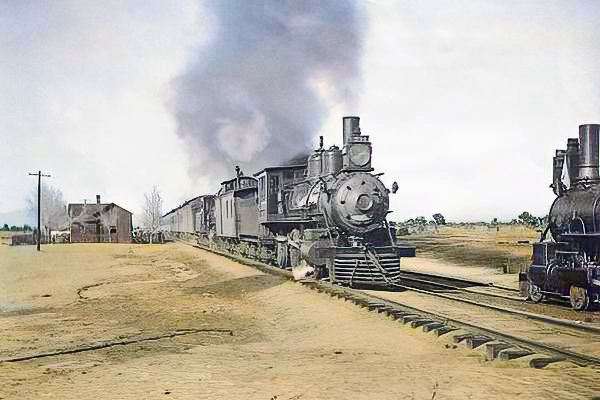
The California Southern Railroad was the Santa Fe's route into Southern California. Organized in 1880, it built north from National City, on San Diego Bay, toward a connection with the Atlantic and Pacific Railroad. Its completion through Cajon Pass in 1885 gave San Diego and Southern California a direct rail route to the East.
Construction began at National City in 1881. Materials, locomotives, rails, and ties had to arrive by ship because the line had no rail connection to the rest of the country. The route ran north through San Diego County, then inland through Temecula Canyon, Elsinore, Perris, Riverside, Colton, San Bernardino, Cajon Pass, Victorville, and Barstow.
The railroad reached Colton on August 15, 1883, where it met the Southern Pacific. The first California Southern train reached San Bernardino on September 13, 1883. These milestones were important, but they did not yet provide the independent eastern connection that Santa Fe and San Diego promoters had sought. The line still depended on interchange arrangements with the Southern Pacific.
In 1884, heavy storms devastated the line through Temecula Canyon. Washouts destroyed bridges, roadbed, and track, leaving the company in serious financial trouble. At the same time, Santa Fe leaders recognized that a line north from San Bernardino through Cajon Pass to Barstow could connect their Southern California route with the Atlantic and Pacific line at Barstow. That extension would create an independent Santa Fe route between the East and San Diego.
Work on the Cajon Pass extension moved quickly in 1885. The Calico Print reported on July 19 that rails were advancing north from the Waterman Bridge area and that construction forces were expected to meet near the Mojave River at Oro Grande. The paper also expected a roundhouse, depot hotel, and a new town at the junction with the Atlantic and Pacific. The completed junction, however, was at Barstow.
The final spike in Cajon Pass was driven on November 9, 1885. Within days, through trains connected National City and San Diego with Barstow, the Atlantic and Pacific, and the eastern rail network. The first Santa Fe passenger trains operated through to the Pacific Coast on November 15, 1885. This was one of the decisive transportation events in Southern California history.
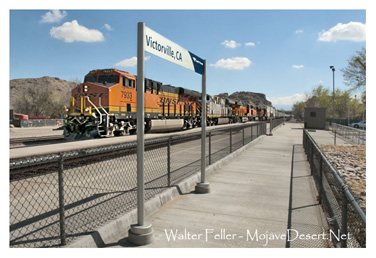
The California Southern helped establish the rail corridor that shaped San Bernardino, Colton, Riverside, Victorville, and Barstow. In the Mojave Desert, Barstow became the important junction between the California Southern and Atlantic and Pacific lines, while the route through Cajon Pass became a lasting gateway between the Los Angeles basin and the desert.
The company itself did not remain independent for long. In 1889, the California Southern, California Central, and Redondo Beach Railway were consolidated as the Southern California Railway. Santa Fe fully acquired the Southern California Railway in January 1906. Thus, 1906 marks the end of the former California Southern as a separate Santa Fe subsidiary, not the date Santa Fe first acquired the California Southern.
Much of the former route survived under Santa Fe and later BNSF operation. The Cajon Pass-Barstow corridor remains one of the West's most important freight routes, while other surviving portions continue to serve passenger and freight traffic.
Contemporary report
The work of constructing the extension of the California Southern is progressing with considerable rapidity. Rails have been laid at a distance of about twenty miles from the junction near the Waterman bridge.It is expected that the construction forces working both ways will meet at the Mojave River near Oro Grande about August 1st.
Calico Print, July 19, 1885.
References
Lesley, Lewis B. "The Entrance of the Santa Fe Railroad into California", Pacific Historical Review, 1939.Dodge, Richard V. "The Fallbrook Line", originally printed in Dispatcher, 1958; reprinted by the San Diego Electric Railway Association.
City of San Bernardino. "A Builder of San Bernardino", including recollections of engineer Fred T. Perris. Victor, Jacob Nash, ed. History of Southern California, Lewis Publishing Company, 1890.
Calico Print, July 19, 1885. California State Railroad Museum Library and Archives, railroad-history collections.

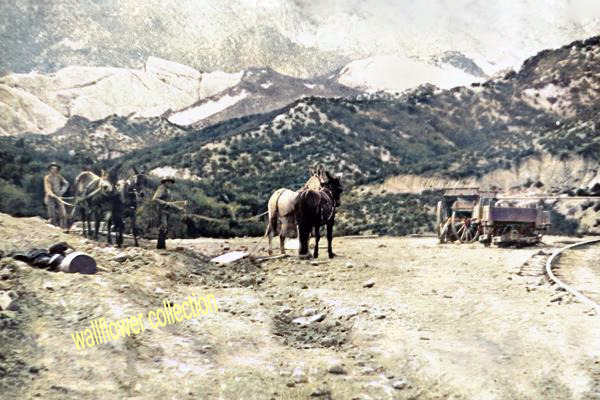
Building California Southern in Cajon Pass
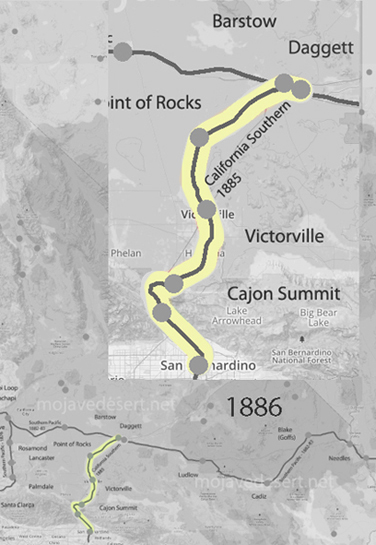
California Southern
The California Southern finds a northerly course from the San Diego County line through this county to its junction with the Atlantic & Pacific at Barstow. It lacks one-fourth of a mile of having 100 miles of main track. In round numbers, a valuation of $522,000 is placed upon its rights and property. This road, with the California Central, is operated by the California Southern Railway Company. The machine shops, etc., of the Sante Fe line at San Bernardino were erected at a cost of $50,000, with stock and machinery, and the company pays out to its employes here the sum of $40,000, all of which goes into circulation in this section.
pg427 illustrated History of socal Lewis 1890
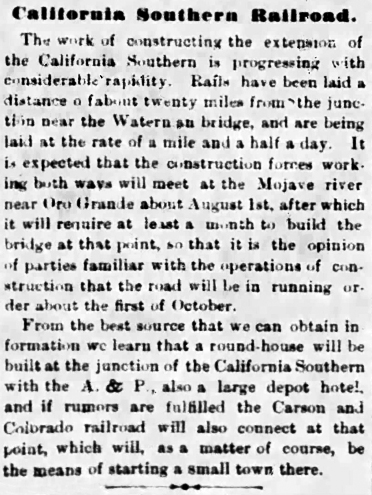
Calico Print 19 July 1885
Barstow is situated at the junction of the California Southern and the A. &. P. Railway, eighty-two miles from San Bernardino and twelve miles from Daggett. It has an elevation of 1,900 feet. The population is about 300. The town is comparatively new. The climate is dry and clear with no fogs or dampness. There is a postoffice, telegraph, telephone and express offices, and daily stage for Calico, connecting with trains, as well as several stores carrying general merchandise, and a large railroad hotel. A silver mine and mill are to be found just north of this place.
History of Southern California - 1890 Lewis Publishing
Jacob Nash Victor
Atlantic & Pacific RR
Cajon Pass History